
Parrot Security OS: Your go-to for computer security.
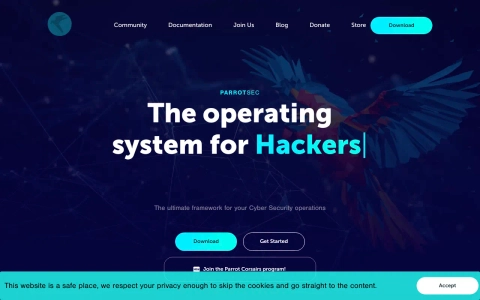
Parrot Security OS is a Debian-based Linux distribution focusing on computer security. It is designed for penetration testing, vulnerability assessment, forensics, and anonymous web browsing. Developed by the Frozenbox team, it offers over 600 tools for various security purposes. Visit Parrotsec.org for more information.
Tags:
#Security#Penetration Testing#Forensics#Anonymous Browsing
FeaturedSubmit Website
- houniao.city

- nextdoor.luokelong.net

- alertbot.com

- quiz.luokelong.net

Target Audience
Parrotsec.org is clearly designed for individuals and organizations deeply involved in computer security, cybersecurity, and digital forensics. This includes penetration testers, ethical hackers, vulnerability analysts, incident responders, and security researchers. The website's focus on providing a specialized Linux distribution tailored for these tasks means its audience will have a certain level of technical proficiency and a need for advanced tools and a secure operating system environment. Furthermore, the mention of "anonymous web browsing" suggests an appeal to privacy-conscious users who may not be professionals but are interested in enhancing their online anonymity. The availability of different editions, such as the "Home Edition" and "Security Edition," indicates a tiered approach, potentially catering to both beginners in security exploration and seasoned professionals requiring robust, purpose-built systems.
The sheer number of downloads (+50M) and community members (+95.5k) advertised on the site strongly suggests a large and active user base. This implies that while the core audience is technically inclined, the project also aims to be accessible and supportive to a broad spectrum of users looking to engage with security-focused operating systems. The inclusion of a "Raspberry Pi Edition" also broadens the potential user base to those interested in embedded systems security or portable security solutions.
Key Highlights
The primary highlight of parrotsec.org is undoubtedly Parrot Security OS itself, a Debian-based Linux distribution meticulously crafted for computer security tasks. The website proudly showcases the OS's comprehensive suite of over 600 pre-installed tools, which are essential for penetration testing, vulnerability assessment, digital forensics, and security auditing. This vast collection of tools eliminates the need for users to manually install and configure individual software packages, offering a streamlined and efficient out-of-the-box experience for security professionals.
Another significant feature is the availability of multiple editions of Parrot OS, catering to diverse user needs. The "Security Edition" is the flagship for professional security work, while the "Home Edition" offers a more general-purpose, privacy-enhanced experience for everyday users. The "HTB Edition" suggests a specific integration or optimization for Hack The Box, a popular cybersecurity training platform, further demonstrating the project's commitment to practical security education. The inclusion of editions for platforms like Raspberry Pi also highlights the OS's versatility and applicability in various hardware contexts. The project's emphasis on community is also a notable highlight, with a large, active community suggesting robust support, ongoing development, and a wealth of shared knowledge.
Privacy & Security Considerations
When interacting with parrotsec.org, visitors should be mindful of general privacy and security practices common to any website, particularly one related to technical tools and operating systems. While the website itself is informational and for downloading an OS, users will likely be prompted to create accounts or provide information if they intend to engage with the community forums or contribute to the project. As with any online service, it's advisable to use strong, unique passwords for any accounts created on the site.
Regarding the OS download, users should ensure they are downloading from the official parrotsec.org domain to avoid compromised or modified versions of the operating system. Verifying checksums provided by the project after downloading an ISO image is a crucial step in ensuring the integrity and authenticity of the operating system. For users who opt to install and use Parrot OS, understanding the security implications of the tools within the OS is paramount. These tools are powerful and, if misused, can have serious legal and ethical consequences. The website's focus on "anonymous web browsing" suggests that users are aware of and concerned about online privacy, which is a positive indicator, but it's always prudent to review the OS's specific privacy policies and settings after installation.
Alternatives
Several well-known Linux distributions cater to the cybersecurity and penetration testing niche, serving as direct alternatives to Parrot Security OS. Kali Linux is perhaps the most prominent competitor, also being Debian-based and offering a vast array of security tools. Like Parrot OS, Kali Linux is designed for professionals and advanced users. In comparison, Parrot Security OS often emphasizes a more user-friendly interface and a broader range of tools beyond just offensive security, with its Home Edition appealing to a wider audience interested in privacy.
Another alternative is BlackArch Linux, which is built upon Arch Linux and also provides an extensive repository of security tools. BlackArch is known for its rolling-release model, offering the latest software updates, which can be appealing to users who prefer cutting-edge technology. However, its Arch Linux base might present a steeper learning curve for some users compared to Parrot's Debian foundation. For users more focused on digital forensics, distributions like CAINE (Computer Aided INvestigative Environment) offer a specialized environment. While Parrot OS integrates forensics capabilities, dedicated forensic distributions often provide a more curated and streamlined workflow for investigators. The choice between these alternatives often comes down to user preference regarding the base distribution (Debian vs. Arch), the specific toolset prioritized, and the desired user experience.